Dental care is one of the single most important things you can address to keep your canine or feline companion healthy and pain-free. Poor dental care leads to heart, liver, and kidney disease, as well as many others. Good dental care leads to a long, healthy, and happy life.
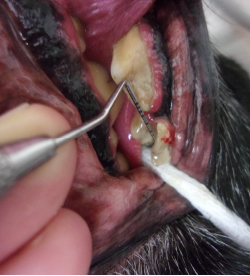
A routine dental examination is a great way to ensure your pet’s mouth, gums and teeth are healthy. Prevention is always better than treatment, and the earlier we can spot potential warning signs, the better.
Dogs and cats over three years old frequently experience periodontal disease. This condition involves plaque and tartar moving below the gumline, resulting in damage to connective tissues and painful lesions— even damaging the jaw.
Dental examinations, even when nothing appears wrong with your pet’s mouth or teeth, are the only way to spot the early signs of periodontal disease and correct the habits, behaviors, or health concerns that are causing it.
Excessive drooling, bleeding, swollen gums, dropped food, or unusually bad breath are considered advanced signs that something may be wrong with your pet's oral health. We strongly encourage routine dental examinations to help detect any issues before your pet experiences these advanced symptoms.
If your pet does have an excessive buildup of plaque in their mouth, the first step we’ll take is to suggest a dental cleaning. These deep cleanings involve the scrubbing away of plaque and tartar, followed by a full polishing of your pet’s teeth. Next, we’ll take care of any specific needs relating to your pet’s oral care— fillings, repairs, etc.
In some cases, we may advise the extraction of a tooth when necessary. We’ll only ever extract a pet’s tooth with the approval of you, the owner. Our team will outline exactly why we recommend a tooth be removed and the hazards associated with leaving it in your pet’s mouth, as well as the benefits of removing it.
All pets are under anesthesia during dental cleanings. Pets can be very protective of their mouths, and anesthetizing them allows them to lie still during the process and not experience unpleasant stress. We do not provide anesthesia-free dentistry at Animal Health Care Denver.
Dental radiography involves taking x-rays of your pet’s mouth to get a clear picture of all their teeth and below the gumline. Radiography can help us identify problems that may not be obvious from a visual exam, particularly when it comes to what’s going on under the gums.
Many of the most serious oral issues can be completely invisible to the naked eye, which is what makes dental x-rays so important. We can identify periodontal disease and other problems, then determine a path forward based on our findings. Dental radiography is completely safe and noninvasive, and is an essential aspect of dental care in special cases.
We want your pet’s oral health to continue long after their dental cleaning or exam at Animal Health Care Denver. That’s why we advise making oral health an ongoing part of your role as an owner. While only some pets will require special or intensive at-home dental care, there are some things all pets can benefit from. These include treats designed to help clean their teeth and gums to occasional brushing.
At your pet’s dental exam, we’ll make recommendations for how to ensure proper oral health for your best friend at home. We’ll also be sure to answer any and all questions you have about what you can do to improve your pet’s dental health. We believe that the best oral care comes from a combined effort between owners and our team here at Animal Health Care Denver.
The CT is based on X-ray technology, but instead of taking just one view per tooth, it takes 600 to 1200 X-ray slices (images) through the entire skull. These slices are then reconstructed into a 3D image. With the 3D image, Animal Health Care Denver is able to see every aspect of every tooth, including the crowns. Crowns often aren’t clearly visible on standard 2D dental X-rays. The 3D scan also allows us to view every aspect of the roots without any parts being cut off (which can happen with 2D X-rays, especially in very small or very large patients). We can also observe how the bone connects to the crown of the tooth, allowing us to check for any level of bone loss.
Because of the 3D nature of the CT scan, bone loss is much more detectable. This is important because bone loss around the periodontal area is indicative of a chronic inflammatory process, inflammation or infection—usually both in the case of dental disease. When a tooth begins to experience bone loss, its natural structure and anatomy become altered. Once the normal anatomy of the tooth is disrupted, the infection and inflammation can never be completely resolved. This is when tooth extraction becomes very important in order to keep the mouth clean and free of infection or pain.
With the CT scan, Animal Health Care Denver can slice each tooth in any direction needed. We can see every aspect of the inside of the tooth, the outside of the tooth, and under the gum line. We are also able to detect abnormally placed teeth, such as when they grow in unusual locations like in the jawbone or in the nasal cavity, which does happen on occasion.
Overall, CT scanning for dental assessment is significantly more sensitive in detecting diseases of the mouth and teeth. Most often, these diseases are painful, so by detecting them with the high sensitivity of the 3D CT scan, Animal Health Care Denver can relieve pets of pain and get them on the road to healing.
In addition, the 3D dental CT scan also evaluates the nose, the nasal cavity, the sinuses, the brain, the inner ears, middle ears, external ears, and part of the neck. This allows us to identify conditions that are completely undetectable on traditional 2D dental X-rays. These include conditions such as middle ear disease—which is surprisingly common and often underdiagnosed—as well as nasal tumors, sinus tumors, nasal infections, and tumors throughout the head and neck.
When we perform a dental procedure at Animal Health Care Denver using our 3D CT scanner, we are not just looking at the surface of your dog’s teeth. We are looking at every aspect of every tooth, including the roots. We are evaluating the entire jawbone, the entire upper jaw, the nasal cavity, the sinuses, the skull, and the ears. This provides a much more thorough picture of your pet’s health during their annual dental care visit.
In addition, Animal Health Care Denver is able to detect disease before it becomes symptomatic, which is just good medicine and helps pets lead the longest, healthiest life possible.
Located in the North Washington suburb of Denver. The hospital is directly off of exit 216 on I-25 and between E 68th Ave and E 66th Ave on Washington St.
Onsite parking available!
Phone: 303-288-6800
Email Us: reception@ahcd.vet